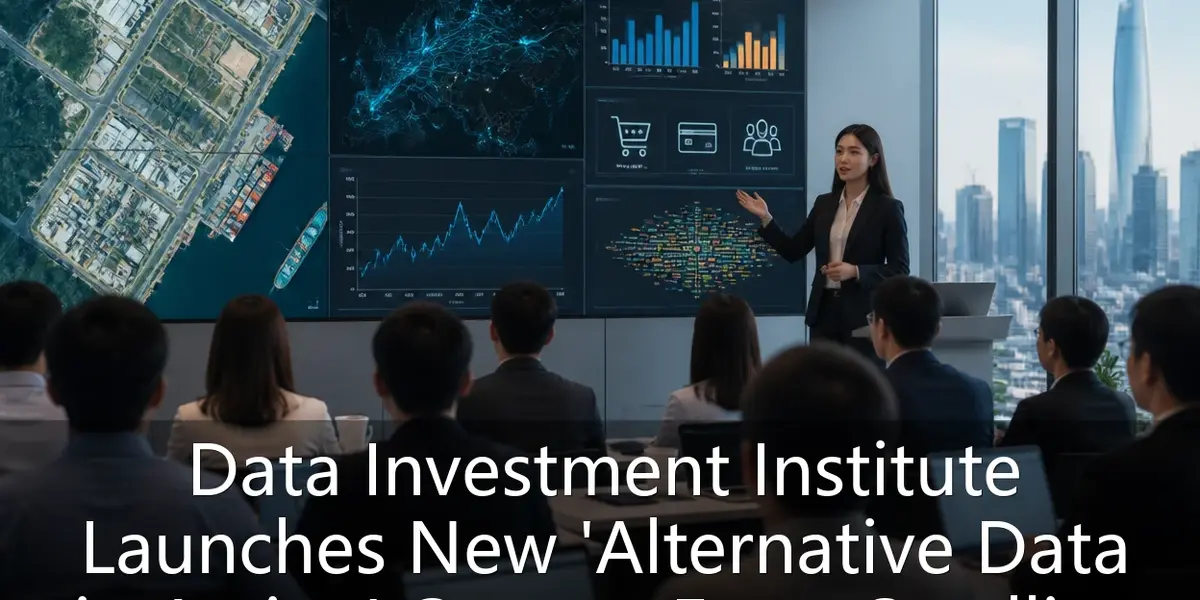
The Rise of Alternative Data: "Information Democratization" in the Investment World
In the information explosion of 2026, traditional financial statements and macro indicators are no longer the sole "holy grail" of investing. When specialized hedge funds track crude oil inventories by analyzing satellite trajectories of oil tankers, or predict a listed company's financial report by scraping e-commerce reviews, are ordinary investors destined to fall behind in this information war? BGU Data Investment Institute gives a resounding no. On August 2, 2026, the institute officially announced the major launch of a new hands-on course on August 15—"Alternative Data and Investment Decision-Making: Mining Alpha from Non-Traditional Data."
The course launch comes at a time of profound change in the global data ecosystem. With the maturation of IoT, AI, and cloud computing technologies, the massive data footprints we generate daily—such as mobile phone location, social media sentiment, and even nighttime light indices—have become valuable mines reflecting economic vitality. However, for most novice investors, these data not only have high acquisition barriers, but their processing and analysis methods present an even more insurmountable professional hurdle.
Course Core: Breaking Institutional Information Monopoly
According to the head of course development at BGU Data Investment Institute, this course is not purely theoretical but focuses on a practical, accessible manual for democratized alternative data that is "obtainable, understandable, and applicable." The course will cover three core modules:
- Alternative Data Landscape and Tool Stack: Systematically sort through the current mainstream global alternative data sources, including but not limited to satellite remote sensing data, app activity, credit card transaction flows, supply chain logistics data, and online public opinion. The course will also provide hands-on guidance on using crawler tools, public APIs, and low-cost third-party data platforms to acquire these resources, solving the primary challenge of "where does the data come from."
- Data Cleaning and Signal Extraction Techniques: Raw alternative data is typically highly noisy and unstructured. This module will explain the core techniques of financial data cleaning, missing value handling, and outlier detection in simple terms. Students will learn how to transform a photo of a crowded parking lot or a complex piece of consumer text into quantifiable investment trend signals.
- Practical Cases and Investment Decision Integration: The course will review multiple classic cases. For example, how to predict a new energy vehicle factory's quarterly delivery volume in advance by monitoring the frequency of truck entries and exits; how to use sentiment indicators on social media to assist in judging short-term market tops and bottoms. The ultimate goal is to combine alternative data signals with traditional financial analysis and macroeconomic data interpretation to build a multi-dimensional, higher-probability investment decision framework.
Why Launch Now? Filling a Gap in Investment Education
Currently, mainstream financial education systems still emphasize traditional financial statement analysis and candlestick chart interpretation. However, market efficiency is rapidly changing due to the widespread application of alternative data. When institutional investors use satellite imagery to count the cars in a Walmart parking lot, thereby locking in performance trends weeks before the earnings report is released, retail investors relying on quarterly disclosures are effectively in a state of severe "information lag."
"We have noticed that in previous courses at the 'Data Investment Institute,' whether 'Financial Data Visualization' or 'Real-time Market Data Stream Analysis,' students have an increasingly urgent need for diversified data sources," said the chief instructor at BGU Data Investment Institute. "This new course is not only a supplement to our existing curriculum but a comprehensive upgrade of investors' data literacy. It no longer just tells you how to use data, but teaches you how to discover and create data perspectives that others don't have."
Furthermore, the course will place special emphasis on risk awareness cultivation. Alternative data is not a panacea; it carries legal compliance risks (such as personal privacy boundaries) and model overfitting risks. The course will guide students to objectively assess the limitations of alternative data, avoid the cognitive bias of "data omnipotence," and establish a scientific risk management mechanism.
Target Audience and Future Outlook
This course is designed for quantitative beginners and experienced retail investors with basic financial knowledge who are eager to advance. Students do not need a strong programming background; the course will provide recommendations for visual analysis tools and basic Python script support, ensuring that investors from various technical backgrounds can benefit.
As China and global capital markets accelerate their embrace of data intelligence, the application of alternative data is moving from the experimental stage to large-scale adoption. This move by BGU Data Investment Institute undoubtedly opens a new door for investors seeking a differentiated competitive advantage. As the course introduction states: "In the future investment world, your excess returns may no longer come from reacting faster to the same data, but from seeing data that others have not yet seen."