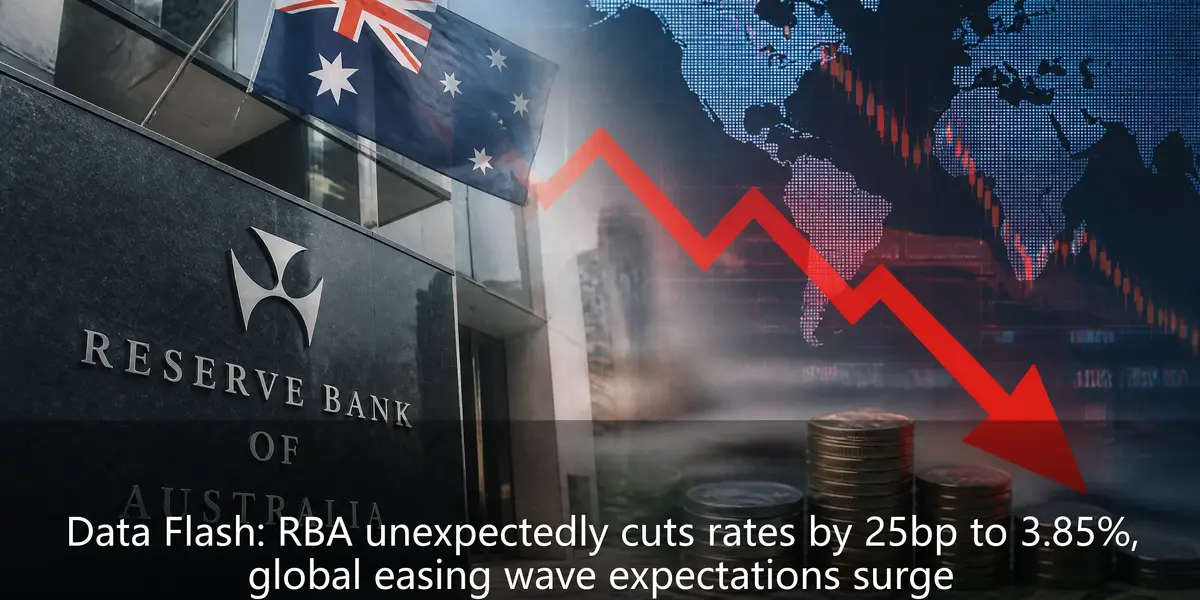
Data Flash: RBA's Surprise Rate Cut Roils Global Financial Markets
At midday Beijing time on August 4, 2026, the Reserve Bank of Australia (RBA) concluded its two-day policy meeting by announcing a 25-basis-point cut to the official cash rate target, bringing it to 3.85%. The decision caught financial markets completely off guard, as the overwhelming majority of economists surveyed by Bloomberg had predicted the rate would remain unchanged at 4.10%. This marks the RBA's first policy adjustment in nearly 18 months since pausing rate hikes in March 2025, officially signaling its entry into a new global easing cycle.
Policy Pivot: From "Maintaining Tightness" to "Precautionary Easing"
RBA Governor Michele Bullock explained in the accompanying policy statement that the decision was based on a series of concerning recent economic data. The statement noted that while the labor market remains tight, household consumption spending has been significantly weaker than expected, and core inflation has declined faster than forecast in May. Data showed Australia's Q2 Consumer Price Index (CPI) year-on-year growth had fallen to 2.7%, approaching the midpoint of the central bank's 2-3% target band, while closely watched retail sales figures have declined month-on-month for three consecutive months.
"The Board judged that a reduction in the cash rate today was an appropriate policy response," Bullock stated. "This will help ease financial pressure on households and businesses and support a soft landing for the economy. We have seen sufficient evidence that the high interest rate environment has effectively curbed demand-side inflationary pressures, and now is the time for fine-tuning." The market widely interpreted this move as a "precautionary rate cut," aimed at preempting a potentially more severe economic slowdown rather than an emergency response to an existing crisis.
Market Turmoil: Aussie Dollar Plunges, Equities Rally
Upon the announcement, financial markets experienced violent swings, becoming a classic market anomaly event captured by data flash services. The foreign exchange market saw the most dramatic reaction, with the Australian dollar plunging over 1.5% against the US dollar within five minutes of the decision, breaking below the 0.64 level to hit a new low for the year. Meanwhile, Australia's ASX 200 index surged, quickly extending gains to 1.8%, led by financial and property sectors, reflecting positive market expectations for lower borrowing costs and a looser monetary environment.
This shockwave rapidly transmitted to global markets. Asia-Pacific equities were broadly boosted, with Japan's Nikkei 225 and South Korea's KOSPI indices extending intraday gains. However, for global macro hedge funds, Australia's unexpected action prompted deeper reflection: if even a resource-exporting nation with a strong labor market like Australia is cutting rates, the headwinds to global growth may be more severe than they appear. This led to a simultaneous rise in both risk aversion and risk appetite, creating a complex market dynamic.
Chain Reaction: Global Easing Wave Expectations Ignited
The RBA's surprise move rapidly altered market pricing models for major central bank monetary policy. Fed funds futures showed traders significantly increased bets on Federal Reserve rate cuts at the September and December meetings following the decision, with the probability of two 25-basis-point cuts this year jumping from 55% the previous day to 72%. Similar large-scale positioning appeared in Eurodollar futures markets, indicating an urgent reassessment of global policy paths.
BGU Data Flash analysts noted that this is not merely a policy adjustment by a single economy but a powerful signal. It suggests that major global central banks are shifting from a coordinated fight against inflation to a defensive posture against downside economic risks. The Bank of Canada, Sweden's Riksbank, and the European Central Bank had already initiated easing cycles, and Australia's move further reinforces this trend. Markets will now closely watch the US ISM Services PMI data due later this week; any unexpected weakness could be amplified and interpreted as a catalyst for the Fed to accelerate its pivot.
The RBA's unexpected rate cut has dropped a bombshell into an already uncertain global financial market. It represents both a classic data-driven policy shift and signals that the global macro trading narrative is rapidly switching from an "inflation story" to a "growth story." For investors, closely monitoring subsequent economic data from various countries, especially marginal changes in labor markets and consumer spending, will be key to navigating this new wave of global easing.