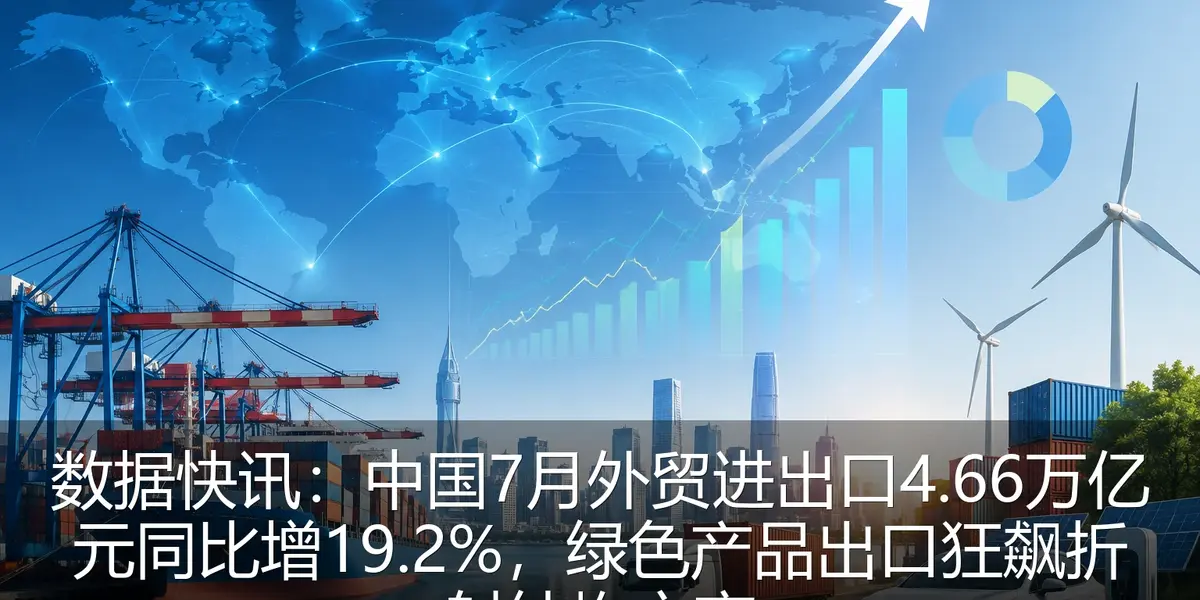
【Data Flash】On August 7, 2026, the General Administration of Customs released the latest foreign trade data showing that China's import and export of goods in July reached 4.66 trillion yuan, a year-on-year increase of 19.2%, continuously exceeding the 4 trillion yuan mark for the fifth consecutive month. Among them, exports increased by 17.8% year-on-year, imports increased by 21.2% year-on-year, with a dual-bo格局 of both import and export continuing. Against the background of fluctuating external demand and trade friction risks, this performance not only verifies the resilience of China's foreign trade "toward the new and better" in the first half of the year, but also sends a clear signal of structural upgrade with eye-catching green product and high-end manufacturing export data.
Core Data Overview: Both Scale and Growth Exceed Expectations
From a cumulative perspective, the import and export value of China's goods in the first seven months reached 30.13 trillion yuan, a year-on-year increase of 17.3%. Among them, exports were 17.44 trillion yuan, an increase of 14%; imports were 12.69 trillion yuan, an increase of 22%. It is worth noting that import growth was 8 percentage points faster than export growth, further improving the trade balance, which also reflects the continuous recovery of domestic demand.
- Single-month import and export value in July was 4.66 trillion yuan, a year-on-year increase of 19.2%, exceeding 4 trillion yuan for five consecutive months;
- In the first seven months, exports of mechanical and electrical products reached 11.12 trillion yuan, a year-on-year increase of 21.2%, accounting for 63.8% of the total export value, an increase of 3.8 percentage points from the same period last year;
- Import value of mechanical and electrical products was 5.31 trillion yuan, a year-on-year increase of 29.7%, accounting for 41.9% of the total import value;
- China's import scale has ranked second globally for 17 consecutive years, with the import volume of bulk commodities increasing by 3% year-on-year.
Lü Daliang, Director of the Statistical Analysis Department of the General Administration of Customs, stated that this year China's economy has been under pressure and moving toward the new and better, providing strong support for the growth of import and export. From the data structure, the growth of foreign trade is no longer simply "volume increase with stable prices", but shows obvious "new kinetic energy-driven" characteristics.
Structural Changes: Green Products and New Quality Productivity Become Export Main Force
The most eye-catching highlight of this data is the accelerated upgrading of export structure. In the first seven months, electric vehicle exports increased by 71.2% year-on-year, lithium battery exports increased by 35.8%, 3D printer exports increased by 1.1 times, industrial robot exports increased by 13.2%, and ship exports increased by 32.7%. This set of numbers means that "new three products" and high-end equipment are growing from "new trade business cards" to real export pillars.
From an industrial logic perspective, green low-carbon transformation and global energy structure adjustment provide long-term demand support for related products. China's industrial chain advantages in fields such as power batteries, photovoltaic components, and smart equipment make it occupy an irreplaceable position in the global supply pattern. For investors, the continuously high-growth categories in foreign trade data often correspond to medium-term industry clues for A-share related sectors—export chain targets in electrical equipment, automobiles, special equipment and other industries are worth tracking.
Import Highlights: Domestic Demand Recovery and "Promoting Stability through Imports"
The import side also shows structural highlights. In the first seven months, the import value of mechanical and electrical products was 5.31 trillion yuan, a year-on-year increase of 29.7%, accounting for 41.9% of the total import value, indicating strong domestic demand for high-end parts and advanced equipment due to manufacturing upgrading; the import volume of bulk commodities increased by 3% year-on-year, reflecting the activity of infrastructure and industrial production. Import growth was significantly faster than export growth, which is conducive to trade balance and balance of payments stability on one hand, and on the other hand shows that China is expanding imports to share market opportunities, hedging against external "decoupling" narratives.
Diversification of Trading Partners: ASEAN Leads, US Decline Narrows
From the perspective of trading partners, China's import and export with more than 180 countries and regions maintained growth. Among them, import and export with ASEAN increased by 20% year-on-year, with the EU increased by 9.5%, with Latin America increased by 15.4%, with Africa increased by 18.9%; import and export with countries along the "Belt and Road" increased by 15.5%, and with other APEC economies increased by 21%. Import and export with the US decreased by 1.6%, but the decline narrowed by 2 percentage points compared to the first six months, showing obvious marginal improvement.
The diversification of trading partner structure significantly reduces dependence on a single market. ASEAN has been China's largest trading partner for many consecutive years, and the dividends of the Regional Comprehensive Economic Partnership Agreement continue to be released; the steady expansion of trade along the "Belt and Road" provides broader incremental space for export enterprises. For exchange rates and cross-border capital flows, the resilience of trade surplus is an important anchor for the RMB exchange rate fundamentals and a key leading indicator for observing balance of payments data.
Transportation Methods and Subject Structure: Air and Land Transport Accelerate, Private Enterprises' Main Position Solid
Transportation method data also reveals details: in the first seven months, waterway, air, highway, and railway transport import and export increased by 6.9%, 34.6%, 40.7%, and 17.2% year-on-year respectively, with air and land transport accounting for 40% of the total import and export value. The high growth of air cargo corresponds to the rapid expansion of cross-border e-commerce and high-value-added electronic products; the growth of China-Europe Express and highway transport reflects the strategic value of land trade channels in the context of supply chain reconstruction.
In terms of subject structure, private enterprises' import and export reached 17.16 trillion yuan, a year-on-year increase of 17.2%, accounting for 56.9% of the national total import and export value, maintaining the position of the largest foreign trade entity; foreign-invested enterprises' import and export increased by 17.6%, and state-owned enterprises increased by 17.3%. The continuous share of private enterprises exceeding half shows strong endogenous momentum in foreign trade, and the adaptability and flexibility of market entities have become key support for stabilizing foreign trade.
Industry Interpretation: Investment Signals and Decision Framework Behind Data
From macro data to investment decisions, foreign trade data is one of the core bridges connecting the real economy and financial markets. For investors, at least three levels can be interpreted from this data:
- First, at the total level, the high growth of import and export confirms external demand resilience, alleviating market concerns about "export drag on GDP", and providing positive support for A-share profit expectations;
- Second, at the structural level, the high growth of green products and mechanical and electrical products provides fundamental verification for new energy, high-end manufacturing and other sectors, and investors can build an "export chain prosperity tracking" industry sector data framework based on this;
- Third, at the risk level, trade with the US is still negative growth, and the uncertainty of external frictions and tariff policies has not been eliminated, and the valuation of export chain targets needs to include a discount for geopolitical risks, and risk awareness cultivation should run through the entire decision-making process.
Risk Warnings and Outlook
Although the data is eye-catching, it is necessary to remain prudent. Factors such as growth slowdown in major global economies, rising trade protectionism, and increased exchange rate fluctuations may all affect the future trend of foreign trade. The high growth in July data was partly due to the low base in the same period last year. After the base effect fades, the year-on-year growth rate in the second half of the year may gradually return to normal. When tracking subsequent monthly data, investors should focus on leading indicators such as new export orders, PMI new export orders sub-item, and RMB real effective exchange rate changes, and avoid being misled by fluctuations in single-month data.
In general, the "stable scale, optimized structure, and new momentum" characteristics shown by the 2026 foreign trade data are an important footnote to China's economic resilience. In the era of data-driven investment, understanding the industry signals behind high-frequency macro data such as the General Administration of Customs is the key step from macro research to investment decisions. BGU Data will continue to track core data such as foreign trade, prices, money, and capital flows, providing timely and professional flash interpretations for investors.