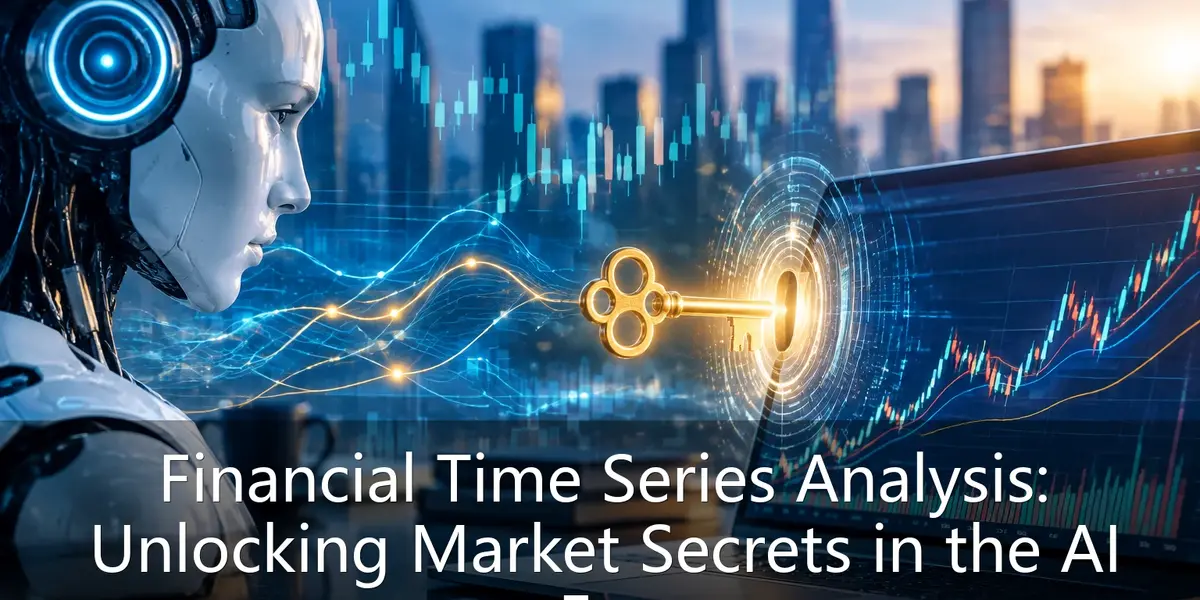
Financial Time Series Analysis: Unlocking Market Secrets in the AI Era
In today's era of data explosion, financial markets are undergoing unprecedented changes. Traditional time series analysis methods face multiple challenges in processing massive data, identifying complex patterns, and making real-time predictions. Meanwhile, the rapid development of artificial intelligence technology has brought revolutionary breakthroughs to financial analysis. This article will delve into the new paradigms, technological breakthroughs, and practical applications of financial time series analysis in the AI era, revealing how advanced data analysis methods can unlock market secrets and provide more precise decision support for investors.
Limitations and Challenges of Traditional Time Series Analysis
Traditional financial time series analysis mainly relies on statistical methods and econometric models, such as ARIMA, GARCH, etc. These methods have provided important tools for financial research in the past few decades, but when facing the complexity and high-dimensional data of modern financial markets, they gradually show limitations:
- Linear Assumption Limitations: Traditional models are mostly based on linear relationship assumptions, making it difficult to capture the nonlinear dynamics widely present in financial markets.
- Inadequate High-Dimensional Data Processing: As the dimensions and complexity of financial market data increase, traditional models struggle to effectively process multivariate, high-dimensional financial data.
- Pattern Recognition Limitations: Traditional methods have difficulty identifying complex patterns and structural changes hidden in the data.
- Real-Time Prediction Challenges: Facing the ever-changing characteristics of the market, the prediction speed and accuracy of traditional models are difficult to meet practical needs.
New Paradigm of Time Series Analysis Empowered by AI Technology
The rise of artificial intelligence technology has brought revolutionary changes to financial time series analysis. Advanced algorithms such as deep learning and reinforcement learning are reshaping the landscape of financial data analysis:
Application of Deep Learning in Time Series Analysis
Deep learning models, especially Recurrent Neural Networks (RNN), Long Short-Term Memory (LSTM) networks, and Gated Recurrent Units (GRU), have shown excellent capabilities in processing sequential data. These models can:
- Capture long-term dependencies, effectively identifying periodic patterns in financial time series
- Process high-dimensional data while considering the combined effects of various market factors
- Adaptively learn market structure changes, improving model robustness
- Achieve end-to-end learning, simplifying traditional multi-step analysis processes
Revolutionary Breakthroughs of Transformer Architecture
The Transformer architecture, initially applied to natural language processing, has shown great potential in financial time series analysis in recent years. Its self-attention mechanism can:
- Capture complex relationships between different time points in time series
- Effectively process long sequence data, solving the gradient vanishing problem of traditional RNNs
- Improve processing efficiency through parallel computing, adapting to real-time application scenarios such as high-frequency trading
Reinforcement Learning and Trading Strategy Optimization
Reinforcement learning provides new ideas for the adaptive optimization of trading strategies. By building an interactive framework between agents and the environment (market), the system can:
- Continuously learn and adjust strategies in dynamically changing market environments
- Balance risk and return to achieve long-term stable growth
- Overcome the adaptability shortcomings of traditional strategies in market mutations
Key Application Areas of Time Series Analysis in the AI Era
AI-enabled time series analysis is playing an important role in multiple financial fields, reshaping industry practices:
Market Prediction and Trend Identification
Market prediction models based on deep learning can integrate multiple data sources, including:
- Market trading data: high-frequency data such as prices, trading volumes, order books, etc.
- Macroeconomic indicators: GDP, inflation rates, employment data, etc.
- Alternative data: social media sentiment, satellite images, web search trends, etc.
- Cross-market correlations: linkage effects between different asset classes
Through multimodal data fusion, AI models can more comprehensively grasp market dynamics and improve prediction accuracy.
Risk Management and Anomaly Detection
The stable operation of financial markets relies on effective risk management. AI-enabled time series analysis can:
- Monitor market anomalies in real-time, providing early warnings for systemic risks
- Build dynamic risk models to adapt to market environmental changes
- Identify complex risk transmission paths, improving the targeting of risk prevention and control
- Optimize asset allocation to achieve risk diversification and return maximization
Quantitative Investment Strategy Development
AI technology is changing the development paradigm of quantitative investment strategies:
- Shift from traditional rule-driven to data-driven approaches, improving strategy adaptability
- Automated feature engineering to reduce human bias
- Strategy portfolio optimization to achieve multi-strategy synergies
- Real-time strategy adjustment to adapt to market changes
Practical Challenges and Solutions
Despite the great potential of AI technology in financial time series analysis, it still faces many challenges in practical applications:
Data Quality Issues
The quality of financial data directly affects model performance. Common problems include:
- Data missing and outlier handling
- Noise filtering in high-frequency data
- Consistent integration of multi-source data
- Data timeliness and integrity assurance
Solutions include establishing comprehensive data cleaning processes, using interpolation techniques to handle missing values, designing robust algorithms to reduce noise impact, etc.
Model Overfitting and Generalization Ability
Complex models tend to perform well on historical data but fail in new environments. Coping strategies:
- Regularization techniques to control model complexity
- Cross-validation to evaluate model generalization ability
- Ensemble learning to improve stability
- Continuous monitoring of model performance with regular updates
Interpretability and Regulatory Compliance
"Black box" models face interpretability challenges, especially in areas with strict financial regulation. Solutions:
- Developing interpretable AI technologies, such as SHAP, LIME methods
- Building hybrid models that combine rule interpretability with data-driven advantages
- Establishing comprehensive model documentation and audit mechanisms
- Ensuring algorithmic fairness to avoid discriminatory decisions
Future Development Trends
Financial time series analysis is developing in the following directions:
Multimodal Data Fusion
Future financial analysis will integrate more types of data sources:
- Text data: news, announcements, social media discussions
- Image data: satellite images, street view photos
- Audio data: meeting recordings, phone records
- Blockchain data: on-chain transactions, smart contract activities
Federated Learning and Privacy Protection
In the context of increasing data privacy importance, distributed learning methods such as federated learning will become mainstream:
- Achieving model training while protecting data privacy
- Promoting inter-institutional collaboration and breaking down data silos
- Reducing risks of centralized data storage
Automation and Intelligence
Financial analysis processes will become more automated and intelligent:
- Automated feature engineering and model selection
- Adaptive parameter adjustment
- Real-time strategy optimization and execution
- Intelligent risk monitoring and early warning
Ethics and Sustainable Development
The development of financial technology will pay more attention to ethical considerations:
- Algorithmic fairness and transparency
- Integration of environmental, social, and governance (ESG) factors
- Responsible AI application
- Inclusive finance and narrowing the digital divide
Conclusion
Financial time series analysis is undergoing a paradigm shift from traditional statistical methods to AI-driven approaches. This transformation not only improves the accuracy and efficiency of data analysis but also provides strong impetus for financial innovation. For investors and financial practitioners, mastering time series analysis techniques in the AI era is not only necessary to enhance competitiveness but also an inevitable choice to adapt to future financial markets.
However, technological progress also brings new challenges. While pursuing higher prediction accuracy and better investment returns, we must be vigilant about model risks, data privacy, and algorithmic bias issues. Only by combining technological innovation with risk management and ethical considerations can we truly achieve sustainable development of financial technology and inject more vitality and wisdom into financial markets.
In the future, with the continuous maturation of AI technology and the accumulation of financial data, financial time series analysis will usher in broader development opportunities. Those who can effectively integrate technology, data, and industry insights will gain the upper hand in this wave of change, unlock more market secrets, and create greater value.