Top-Level Design and Practice Path for Sci-Tech Finance Data Development and Utilization — Based on the Nine-Department Notice: In-depth Interpretation and Outlook
Keywords
Sci-Tech Finance; Data Co-construction and Sharing; Data Development and Utilization; Sci-Tech Innovation; Financial Empowerment; Digital Credit; Industrial Chain Finance
Introduction
The new round of technological revolution and industrial transformation is accelerating. As the core force of innovation-driven development, sci-tech enterprises have diversified and complex financing needs. However, these enterprises are generally characterized by light assets, high investment, long cycles, and high uncertainty, making it difficult for traditional credit models to accurately assess their credit risk, leading to persistent financing difficulties and high costs. As a new production factor, data plays an irreplaceable role in solving information asymmetry and optimizing financial resource allocation. Recently, nine departments—the People's Bank of China, the National Development and Reform Commission, the Ministry of Science and Technology, the Ministry of Industry and Information Technology, the General Administration of Customs, the State Administration for Market Regulation, the National Financial Regulatory Administration, the China National Intellectual Property Administration, and the National Data Administration—jointly issued the "Notice on Strengthening Data Development and Utilization in the Sci-Tech Finance Field" (hereinafter referred to as the "Notice"), marking a new stage of systematic, collaborative, and secure governance of sci-tech finance data. This policy is not only a key measure to implement the strategic deployment of the CPC Central Committee and the State Council to "accelerate the development of sci-tech finance and make a big article of sci-tech finance," but also an important practice to promote market-oriented allocation reform of data factors and empower high-quality development of the real economy. This article will deeply interpret the core content of the Notice from three dimensions: policy framework, open sharing, and full-chain empowerment, and look forward to the future practice path of sci-tech finance data development and utilization.
I. Policy Framework and Data Catalog: Building the "Four Beams and Eight Pillars" of Sci-Tech Finance Data Governance
The core highlight of the Notice is the first systematic proposal of the top-level design for data development and utilization in the sci-tech finance field, among which the release of the "National Sci-Tech Finance Data Development and Utilization Catalog 1.0" is a milestone. This catalog covers eight categories and twenty-six data indicators, including enterprise list and sci-tech attributes, import and export, investment and financing, operations, R&D investment, intellectual property, innovation capability evaluation, and enterprise needs, covering almost all major characteristic dimensions of the full life cycle of sci-tech enterprises. It is noteworthy that the catalog includes "innovation capability evaluation" and "enterprise needs" in the data collection scope, reflecting a shift from "static portrait" to "dynamic service"—not only focusing on the enterprise's past R&D strength, but also on its future growth potential and real-time financial needs.
From the governance structure, the Notice proposes a three-layer promotion mechanism of "central coordination, local characteristics, and facility interconnection." At the central level, a unified catalog system is established to ensure data standardization and comparability. At the local level, regions are supported to form "sci-tech finance data development and utilization lists" based on regional industrial characteristics. For example, in integrated circuit industry clusters, the integration of intellectual property and upstream/downstream data can be strengthened; in biomedical industry clusters, data collection on clinical trial R&D investment and drug approval progress can be emphasized. At the infrastructure level, the construction of provincial sci-tech finance data development and utilization supporting information facilities is required, along with strengthening the interconnection of existing information system resources to break "data silos." This design respects the differences in industrial development across regions while avoiding duplication and standard confusion.
Data security is the lifeline of data development and utilization. The Notice particularly emphasizes "adhering to the coordinated development and security," requiring full-process security management for the development and utilization of sci-tech public data. This means that data sharing is not simply "letting go," but embedding security protection mechanisms in all stages including rights confirmation, collection, storage, circulation, use, and destruction. For example, for sensitive data involving trade secrets and core patents, trusted data space technologies that are "usable but invisible" can be adopted; for sensitive data such as personal information, strict compliance with laws and regulations like the Personal Information Protection Law is required. The implementation of this concept will effectively prevent risks such as data leakage, data abuse, and data monopoly, providing a solid compliance foundation for sci-tech finance data governance.
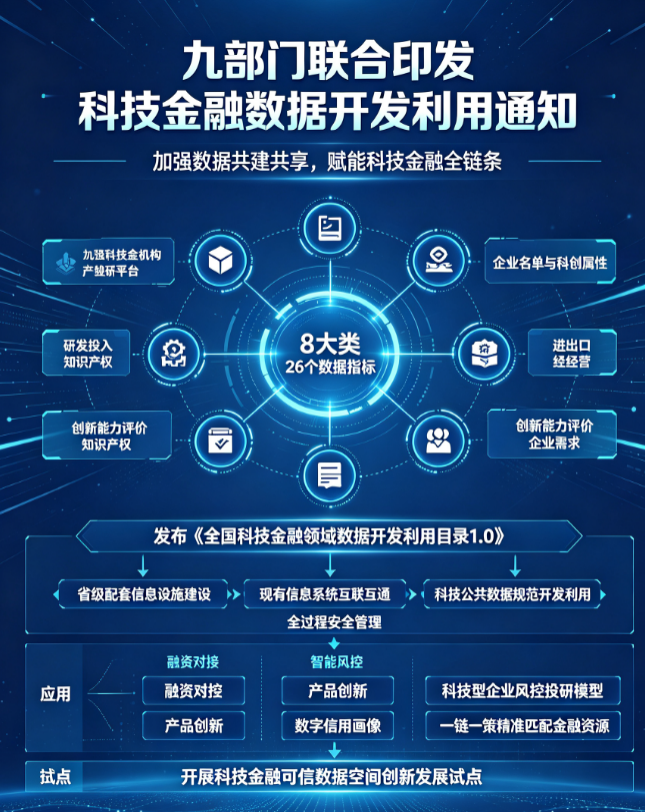
The above figure intuitively shows the three-layer architecture of sci-tech finance data development and utilization constructed by the Notice: the bottom layer is data infrastructure, including central catalog, provincial facilities, and institutional systems; the middle layer is data governance and security system, covering full life cycle management; the top layer is data application and service, covering enterprise portrait, risk assessment, product innovation, etc.
II. Open Sharing and Integrated Application: Activating the "Multiplier Effect" of Data Factors
Data can only generate value when circulated. In traditional sci-tech finance practice, data is often scattered among government departments, financial institutions, credit bureaus, public platforms, and other entities, lacking effective sharing mechanisms. For example, intellectual property data is held by the intellectual property department, import and export data by the customs department, R&D investment data may be scattered among science and technology and tax departments, while enterprise revenue and expenditure data mainly resides in banks. This "fragmented" pattern severely restricts the comprehensive utility of data.
To address this pain point, the Notice explicitly proposes multiple measures to "strengthen open sharing and integrated application of sci-tech finance data." First, it supports sci-tech information using institutions to standardize the application of sci-tech public data, meaning that eligible banks, investment institutions, guarantee companies, etc., can legally access public data held by the government. Second, it encourages localities to provide authorized open information channels for sci-tech enterprises, allowing enterprises to actively authorize financial institutions to query their relevant data, respecting the data subject's right to know and consent, while simplifying the data acquisition process for financial institutions. Third, it promotes models such as information query and joint modeling. Information query is suitable for single, low-frequency data requests; joint modeling is suitable for scenarios that require deep mining of data intrinsic patterns, such as banks and tax departments jointly establishing a "tax-bank interaction" model to automate the approval of unsecured loans for small and micro enterprises.
Particularly noteworthy is that the Notice proposes to "carry out pilot innovation development of sci-tech finance trusted data spaces." Trusted data spaces are new types of data circulation infrastructure based on technologies such as privacy computing, blockchain, and federated learning, enabling cross-domain sharing of data value without exposing raw data. For example, a sci-tech enterprise's intellectual property data is stored at the China National Intellectual Property Administration, its R&D investment data at the science department, and its bank transaction data at its account bank. These three types of data can achieve "data immobile, model mobile" through the trusted data space—each data provider only outputs calculation results (e.g., credit score) without transmitting raw data, thereby enabling data integration while ensuring security. In addition, the Notice encourages regions with conditions to strengthen the open utilization of enterprise revenue and expenditure data and to build industry research information exchange platforms. Enterprise revenue and expenditure data can truthfully reflect key information such as business activity, cash flow cycles, and transaction stability, serving as an important basis for judging an enterprise's debt-paying ability. The opening of this data will greatly improve the accuracy of sci-tech enterprise credit assessment.
At the market level, the Notice explicitly supports market-oriented credit bureaus to build sci-tech enterprise databases, enriching credit product and service supply. Currently, China's credit reporting system is centered on the basic financial credit information database, which mainly collects credit information and lacks coverage of non-credit information of sci-tech enterprises (such as intellectual property, R&D activities, talent teams). Market-oriented credit bureaus can leverage their flexibility to develop special products such as professional and new (specialized and sophisticated) credit evaluation models and sci-tech enterprise indices, filling market gaps. For example, a credit bureau can build an analysis chain of "patent quality—technology transformation—market valuation" based on intellectual property data, providing decision-making reference for investment-loan linkage business.
III. Data Empowering the Full Chain of Sci-Tech Finance: From "Financing Matchmaking" to "Intelligent Risk Control" to "Product Innovation"
The ultimate focus of the Notice is to improve the full-chain service capability of data-empowered sci-tech finance, focusing on three key links: "financing matchmaking," "intelligent risk control," and "product innovation."
In the financing matchmaking stage, under the traditional model, sci-tech enterprises need to submit materials to each bank and await approval, which is inefficient and lacks transparency. The Notice proposes to guide financial institutions to build "digital credit profiles" of sci-tech enterprises based on the sci-tech finance database. The so-called "digital credit profile" is a dynamic, three-dimensional credit evaluation system formed by integrating multi-dimensional data of enterprises, converting scattered fragmented information into quantifiable and comparable credit labels. For example, a biotech company established only three years ago with no profit record can be rated as a "high-growth" customer based on its patent count, R&D investment ratio, core team academic background, clinical trial progress, etc., matching products such as angel investment and intellectual property pledge loans. This profile not only serves financial institutions but can also interface with government risk compensation funds, achieving "government-bank-enterprise" data linkage.
In the intelligent risk control stage, the risks of sci-tech enterprises are nonlinear and sudden, making traditional static risk control models centered on financial indicators difficult to adapt. The Notice encourages financial institutions to create "characteristic sci-tech enterprise risk control and investment research models." The innovations of such models include: first, introducing non-traditional data sources such as enterprise electricity consumption, social insurance payment numbers (reflecting operation rate), bidding records (reflecting market recognition), and patent citation frequency (reflecting technological influence) to establish "leading" risk warning indicators; second, using machine learning algorithms to mine nonlinear relationships between data, such as discovering that the combination of "R&D investment intensity exceeding 15% and patent grant rate below 30%" often indicates a high risk of technological route failure; third, deep integration of risk models and investment research models to not only assess current default probability but also predict future enterprise valuation changes, supporting innovative businesses such as investment-loan linkage and warrant loans.
In the product innovation stage, to truly achieve "precise drip irrigation" in sci-tech finance, differentiated products must be developed based on sub-industry characteristics. The Notice specifically proposes "one chain, one policy" to precisely match financial resources, which relies on the capability of industrial chain big data analysis. Specifically, financial institutions can cooperate with relevant departments to analyze capital flow in the industrial chain using data on transaction concentration, counterparty distribution, and counterparty stability, thereby drawing key industrial chain maps. For example, in the new energy vehicle industry chain, core enterprises (such as vehicle manufacturers) have higher credit ratings, but their upstream and downstream small and medium sci-tech suppliers (such as battery parts manufacturers, motor manufacturers) often lack collateral. Through industrial chain map analysis, financial institutions can identify these SMEs' transaction status, cash flow cycles, order stability, etc., in the core enterprise supply chain, designing product combinations mainly based on accounts receivable pledge, order financing, and inventory financing, and leveraging the core enterprise's credit to achieve "chain-driven lending." This "one chain, one policy" model avoids the crude "one-size-fits-all" lending and truly aligns financing solutions with industrial laws.
Conclusion
The release of the "Notice on Strengthening Data Development and Utilization in the Sci-Tech Finance Field" is a milestone breakthrough in the market-oriented reform of data factors in the sci-tech finance field. It takes "data catalog—infrastructure—security norms—open sharing—full-chain empowerment" as the logical main line, constructing a complete policy closed loop for sci-tech finance data development and utilization. Through unified catalogs to achieve data standardization, local lists to achieve specialization, interconnection to achieve intensification, trusted data spaces to achieve security, and finally through data integration and application to achieve precision in financial services. The implementation of this framework is expected to fundamentally solve the information asymmetry problem in sci-tech enterprise financing, tilt financial resources towards enterprises with strong innovation capabilities and high technology content, and provide a strong data driving force for cultivating new quality productive forces.
Looking ahead, the development and utilization of sci-tech finance data still needs to be continuously deepened in the following aspects: first, the data rights confirmation issue, especially the revenue distribution mechanism for authorized operation of public data, needs to be clarified; second, cross-departmental coordination costs, although the Notice requires strengthening interconnection, departmental barriers may still restrict data circulation efficiency in practice; third, the large-scale application of new technologies such as privacy computing requires the establishment of unified technical standards and evaluation systems; fourth, data ethics issues, avoiding "misjudgment" of enterprises due to excessive data collection or algorithmic bias. Only by adhering to "both security and development, both openness and regulation" can sci-tech finance data truly become an "accelerator" for promoting sci-tech innovation and high-quality financial development.