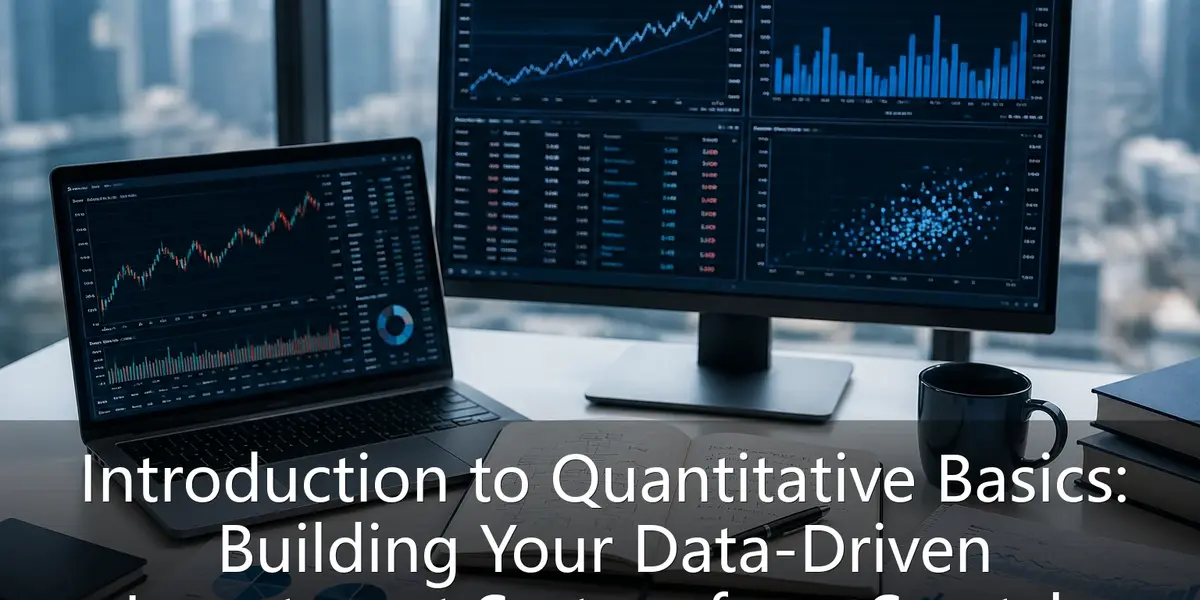
Introduction to Quantitative Basics: Building Your Data-Driven Investment System from Scratch
In today's digital wave sweeping global financial markets, quantitative investment has become an indispensable tool for professional investors. For beginners, how to build their own data-driven investment system from scratch has become a focus of attention for many. This article will systematically introduce the basics of quantitative investment, covering data collection, cleaning, analysis, and strategy construction, providing a complete learning path for beginners.
I. Concept and Advantages of Quantitative Investment
Quantitative investment, simply put, is the process of making investment decisions using mathematical models and computer programs. Compared with traditional investment methods, quantitative investment has obvious advantages:
- Objectivity: Based on data and algorithms, reducing human emotional influence
- Consistency: Strictly executing preset strategies to avoid arbitrary decisions
- Efficiency: Quickly processing large amounts of data to discover market opportunities
- Backtestable: Validating strategy effectiveness with historical data
With the development of FinTech, quantitative investment has gradually spread from a professional tool on Wall Street to ordinary investors, becoming a new paradigm of investment in the data era.
II. Core Elements of Data-Driven Investment
A data-driven investment system consists of four core elements: data collection, data processing, model building, and strategy execution.
1. Data Collection: The Foundation of Investment Decision-Making
High-quality data is the key to the success of quantitative investment. Beginners need to focus on the following types of data:
- Price Data: Including historical prices, trading volume, trading amount, etc.
- Fundamental Data: Financial statements, industry data, macroeconomic indicators
- Alternative Data: Satellite images, social media sentiment, search indices, etc.
- Market Data: Order books, market sentiment indicators, capital flows
Beginners can start with public data sources such as Yahoo Finance, Quandl, Wind, etc., and gradually build their own data warehouses.
2. Data Processing: Cleaning and Preprocessing
Raw data often has issues such as missing values and outliers, requiring preprocessing:
- Data Cleaning: Handling missing values, outliers, and duplicate data
- Data Standardization: Unifying formats and units of different data sources
- Feature Engineering: Extracting valuable features, such as technical indicators, financial ratios
- Data Storage: Selecting appropriate databases for storage and management
The Pandas library in Python is a powerful tool for data processing, and beginners should master its basic operations.
III. Quantitative Analysis Tools and Platforms
Building a quantitative investment system requires appropriate tools and platform support:
1. Programming Languages
Python is the preferred language for quantitative investment, and its rich libraries and community support make it an industry standard:
- Pandas: Data processing and analysis
- Numpy: Numerical computation
- Scikit-learn: Machine learning algorithms
- Ta-Lib: Technical indicator calculation
- Backtrader: Backtesting framework
2. Trading Platforms
Selecting an appropriate trading platform is crucial for beginners:
- Simulated Trading Platforms: Such as QuantConnect, Zipline, providing free backtesting environments
- Live Trading Platforms: Such as Interactive Brokers, Tiger Securities
- Cloud Platforms: Such as AWS, Google Cloud, providing computing resources
IV. Types and Construction of Quantitative Strategies
Quantitative strategies can be classified according to different criteria, and beginners can start with the following types:
1. Technical Analysis Strategies
Based on historical price and volume data:
- Trend Following: Such as moving average crossover, MACD
- Mean Reversion: Such as Bollinger Bands, RSI overbought/oversold
- Pattern Recognition: Such as head and shoulders, double bottom
2. Fundamental Strategies
Based on company financial data and fundamental indicators:
- Value Investing: Such as P/E ratio, P/B ratio screening
- Growth Investing: Such as revenue growth rate, profit growth rate
- Quality Factors: Such as ROE, gross margin, debt ratio
3. Statistical Arbitrage Strategies
Utilizing statistical relationships between assets:
- Pair Trading: Spread trading between correlated stocks
- Multi-Factor Models: Combining multiple factors to build investment portfolios
- Machine Learning Strategies: Such as random forest, neural network prediction
V. Backtesting and Optimization: Verifying Strategy Effectiveness
Backtesting is a key step in quantitative strategy development, verifying the effectiveness of strategies through historical data:
- In-Sample Testing: Using part of historical data for training and testing
- Out-of-Sample Testing: Using data not involved in training for validation
- Overfitting Check: Avoiding strategies that perform well on training data but fail in practice
- Parameter Optimization: Finding the optimal parameter combination, but beware of over-optimization risks
Common backtesting metrics include Sharpe ratio, maximum drawdown, annualized return, etc., which help evaluate the risk-return characteristics of the strategy.
VI. Risk Management: The Lifeline of Quantitative Investment
Risk management is an indispensable part of quantitative investment:
- Position Management: Determining position size based on risk tolerance
- Stop-Loss Strategy: Setting reasonable stop-loss points
- Diversification: Reducing unsystematic risk through asset allocation
- Stress Testing: Simulating strategy performance under extreme market conditions
Effective risk management can protect capital and ensure the stability of strategies in long-term operation.
VII. Practical Case: Building the First Quantitative Strategy
Let's demonstrate the entire process of quantitative investment through a simple moving average crossover strategy:
1. Strategy Idea
Buy when the short-term moving average crosses above the long-term moving average, and sell otherwise.
2. Data Preparation
Obtain historical price data of a stock and calculate short-term (e.g., 20-day) and long-term (e.g., 60-day) moving averages.
3. Strategy Implementation
Implement the strategy logic using Python and generate trading signals.
4. Backtest Analysis
Backtest the strategy on historical data and calculate metrics such as return rate, maximum drawdown, etc.
5. Optimization and Adjustment
Adjust parameters based on backtest results, such as moving average periods, or add other filtering conditions.
VIII. Learning Path and Resource Recommendations
For beginners, it is recommended to follow the following learning path:
- Basic Stage: Learn Python programming and basic data analysis
- Intermediate Stage: Master quantitative strategy construction and backtesting methods
- Advanced Stage: In-depth study of machine learning applications in quantitative investment
Recommended resources include:
- Online Courses: Quantitative investment courses on Coursera, Udemy
- Books: "Quantitative Trading", "Machine Learning Applications in Finance"
- Communities: Quantitative investment communities such as Quantopian, Kaggle
- Practice Platforms: Participate in quantitative competitions to accumulate practical experience
IX. Common Misconceptions and Precautions
Beginners often make the following mistakes in the process of quantitative investment:
- Overfitting: Strategies perform well on historical data but fail in practice
- Ignoring Transaction Costs: Transaction fees and slippage in actual trading affect strategy returns
- Lack of Risk Management: No reasonable stop-loss and position management
- Data Quality Issues: Using inaccurate or outdated data
- Emotional Influence: Even when using quantitative methods, one may still be affected by market sentiment
Avoiding these misconceptions requires continuous learning and practice, and establishing a correct concept of quantitative investment.
X. Future Trends and Outlook
The field of quantitative investment is continuously developing, and future trends include:
- Deep Integration of Artificial Intelligence and Machine Learning: More complex prediction models and strategy optimization
- Widespread Use of Alternative Data: Value mining of non-traditional data sources
- Cloud Computing and Big Data Technology: More powerful computing power and data processing capabilities
- RegTech (Regulatory Technology): Automated processing of compliance requirements
- Personalized Investment: Customized strategies based on individual characteristics and preferences
For beginners, keeping up with technological development trends and continuously learning new knowledge is the key to maintaining competitiveness.
Conclusion
Quantitative investment is a complex but opportunity-rich field. Building a data-driven investment system from scratch requires continuous learning and practice, but once mastered, it will bring unique advantages to investors. Through this article, we hope beginners can establish a correct understanding of quantitative investment, embark on the learning journey of quantitative investment, and seize investment opportunities in the data-driven financial era.