Introduction to Quantitative Models: Building Your First Data-Driven Investment Strategy
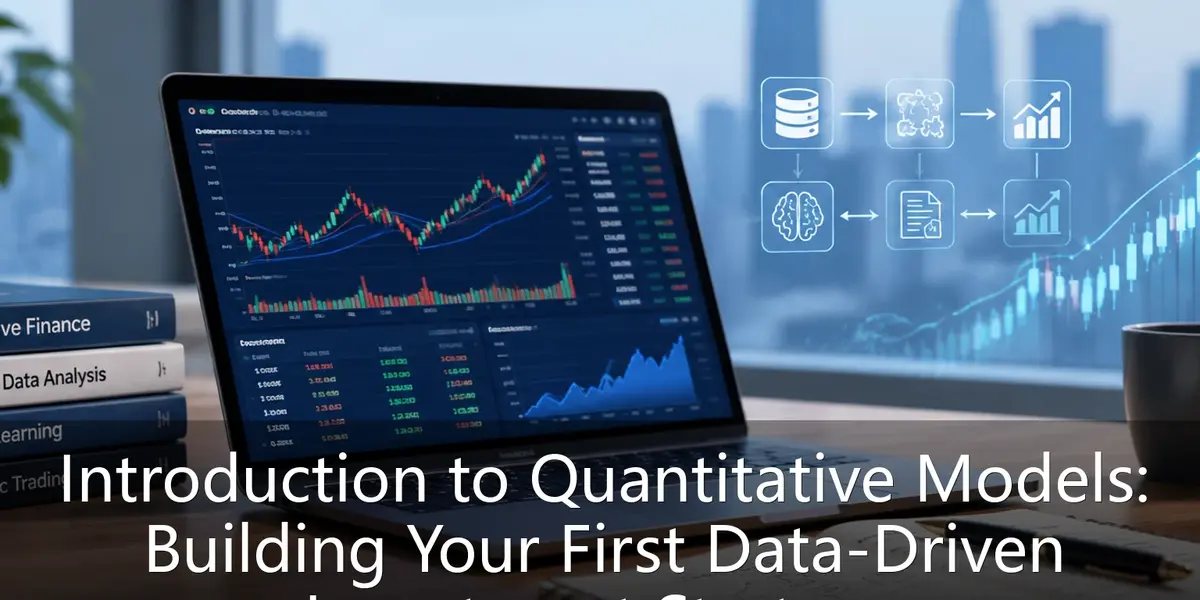
\nIn today's digital age, financial markets are undergoing unprecedented changes. The traditional investment decision-making model that relies on intuition and experience is gradually being replaced by data-driven quantitative methods. Quantitative investment uses mathematical models and algorithms to analyze market data, making investment decisions in a systematic and objective manner, and has become an important part of modern investment. This article will guide beginners to understand the basic construction methods of quantitative models in depth, from theory to practice, step by step to build your first data-driven investment strategy.
\n\nBasic Principles of Quantitative Investment
\nQuantitative investment is a method of making investment decisions using mathematical models and computer programs. Unlike traditional investment, quantitative investment emphasizes objectivity and systematicity, finding investment patterns with statistical significance through extensive historical data backtesting and statistical analysis. The core of quantitative investment lies in transforming investment ideas into executable mathematical models and executing trades automatically through computer programs.
\nThe basic principles of quantitative investment can be summarized as follows:
\n- \n
- Data-driven: Analysis and decision-making based on historical market data \n
- Modeling: Transforming investment logic into mathematical models \n
- Systematic: Establishing clear rules and processes to reduce human intervention \n
- Continuous optimization: Continuously adjusting and improving models through backtesting and live performance \n
Advantages and Challenges of Quantitative Investment
\nQuantitative investment has multiple advantages compared to traditional investment methods:
\n- \n
- Objectivity: Reducing emotional decisions and avoiding common cognitive biases \n
- Systematicity: Ability to process large amounts of data simultaneously and discover patterns that are difficult for humans to detect \n
- Execution capability: Ability to strictly execute strategies without hesitation or over-trading \n
- Backtestability: Ability to verify strategy effectiveness on historical data \n
However, quantitative investment also faces many challenges:
\n- \n
- Data quality and availability issues \n
- Risk of model overfitting \n
- Strategy failure due to market structure changes \n
- Higher requirements for technology and infrastructure \n
Steps to Build a Quantitative Model
\nBuilding an effective quantitative model requires several key steps:
\n\n1. Clarify Investment Objectives and Constraints
\nBefore starting to build a quantitative model, it is first necessary to clarify investment objectives and constraints. This includes:
\n- \n
- Investment horizon: short-term, medium-term, or long-term \n
- Risk tolerance: maximum drawdown that can be accepted \n
- Return objectives: expected annualized return rate \n
- Investment scope: stocks, bonds, futures, or foreign exchange markets \n
- Trading frequency: high-frequency, medium-frequency, or low-frequency trading \n
Clarifying these conditions will help determine the appropriate quantitative strategy type and parameter settings.
\n\n2. Data Collection and Preprocessing
\nData is the foundation of quantitative investment, and high-quality data is crucial for building effective models. Data collection and preprocessing include the following:
\n- \n
- Data source selection: Determine appropriate data sources, such as historical price data, financial data, macroeconomic data, etc. \n
- Data cleaning: Handle missing values and outliers to ensure data quality \n
- Data standardization: Standardize data from different sources to make them comparable \n
- Feature engineering: Extract valuable features from raw data, such as technical indicators, financial ratios, etc. \n
Good data preprocessing can significantly improve model performance and stability.
\n\n3. Strategy Ideas and Model Design
\nStrategy ideas are the core of quantitative models, requiring investment concepts to be transformed into specific mathematical models. Common quantitative strategy types include:
\n- \n
- Trend-following strategies: Trading based on price trends, such as moving average crossover strategies \n
- Mean reversion strategies: Trading based on the characteristic that prices revert to the mean after deviation \n
- Statistical arbitrage strategies: Using statistical relationships between assets for arbitrage \n
- Factor investment strategies: Building investment portfolios based on factors such as value, growth, and quality \n
- Event-driven strategies: Trading based on specific events (such as earnings releases) \n
After selecting an appropriate strategy type, specific mathematical models need to be designed, including signal generation, position management, stop-loss, and take-profit rules.
\n\n4. Backtesting and Optimization
\nBacktesting is a key step in verifying the effectiveness of quantitative models. By testing model performance on historical data, the feasibility and potential risks of the strategy can be evaluated. The backtesting process includes:
\n- \n
- Historical data splitting: Divide data into training, validation, and test sets \n
- Performance metric calculation: Calculate metrics such as return rate, Sharpe ratio, maximum drawdown, etc. \n
- Parameter optimization: Adjust model parameters to optimize performance \n
- Overfitting detection: Ensure the model performs well on out-of-sample data \n
It should be noted that backtest results do not represent live performance but can provide valuable references.
\n\n5. Risk Management
\nEffective risk management is key to the success of quantitative investment. Common risk management methods include:
\n- \n
- Position control: Determine appropriate position sizes based on market volatility and strategy characteristics \n
- Stop-loss and take-profit: Set clear stop-loss and take-profit points \n
- Diversification: Reduce concentration risk by investing in multiple assets or strategies \n
- Stress testing: Simulate strategy performance under extreme market conditions \n
Building Your First Quantitative Model
\nThe following takes a simple moving average crossover strategy as an example to introduce the process of building a quantitative model.
\n\nStrategy Description
\nThe moving average crossover strategy is a classic trend-following strategy that generates trading signals through the crossover of short-term and long-term moving averages. When the short-term moving average crosses above the long-term moving average, a buy signal is generated. When the short-term moving average crosses below the long-term moving average, a sell signal is generated.
\n\nData Preparation
\nFirst, historical price data for stocks needs to be obtained, including opening price, highest price, lowest price, closing price, and trading volume. Then calculate short-term and long-term moving averages, such as 20-day and 60-day moving averages.
\n\nSignal Generation
\nGenerate trading signals by comparing the positions of short-term and long-term moving averages:
\n- \n
- When the 20-day moving average crosses above the 60-day moving average, generate a buy signal \n
- When the 20-day moving average crosses below the 60-day moving average, generate a sell signal \n
Backtesting Analysis
\nTest the strategy's performance on historical data and calculate the following metrics:
\n- \n
- Total return rate \n
- Annualized return rate \n
- Maximum drawdown \n
- Sharpe ratio \n
- Number of trades \n
Strategy Optimization
\nThe strategy performance can be optimized by adjusting the parameters of the moving averages, such as trying different moving average combinations (such as 10-day and 30-day moving averages) or adding other filtering conditions (such as volume confirmation).
\n\nQuantitative Investment Tools and Platforms
\nFor beginners, choosing appropriate quantitative investment tools and platforms is very important. Here are some commonly used quantitative investment tools:
\n- \n
- Python: A powerful programming language with rich financial data analysis libraries, such as Pandas, NumPy, TA-Lib, etc. \n
- Quantopian: A cloud-based quantitative trading platform that provides historical data and backtesting environments \n
- TradingView: A trading platform that provides charting tools and strategy testing functions \n
- Ju Kong: A leading domestic quantitative trading platform that provides rich data interfaces and backtesting tools \n
- Mi Kuang: A professional domestic quantitative trading platform that supports multi-market trading such as stocks and futures \n
Learning Path for Quantitative Investment
\nFor beginners, learning quantitative investment can be divided into the following stages:
\n\n1. Basic Knowledge Stage
\nMaster basic financial market knowledge, statistical foundations, and programming basics, especially the Python programming language. Understand basic financial concepts and the fundamental principles of quantitative investment.
\n\n2. Data Processing Stage
\nLearn methods for acquiring, cleaning, and processing financial data, and master basic skills in data analysis and visualization. Familiarize yourself with common financial data sources and API interfaces.
\n\n3. Model Building Stage
\nLearn common quantitative strategies and model building methods, and master backtesting and optimization techniques. Understand the characteristics and applicable scenarios of different types of quantitative strategies.
\n\n4. Live Trading Stage
\nAfter mastering the basics, you can gradually try small capital live trading to accumulate practical experience. Pay attention to risk control and capital management.
\n\nCommon Misconceptions in Quantitative Investment
\nBeginners often fall into the following pitfalls when building quantitative models:
\n- \n
- Overfitting: Over-optimizing model parameters, leading to good performance on historical data but poor performance in live trading \n
- Ignoring transaction costs: Not considering transaction costs such as commissions and slippage, overestimating strategy returns \n
- Data snooping: Repeatedly searching for "patterns" in data, leading to false discoveries \n
- Ignoring market structure changes: Not considering the impact of market environment changes on strategies \n
- Lack of risk awareness: Over-pursuing high returns while ignoring risk management \n
Future Development Trends
\nThe field of quantitative investment is developing rapidly, and the following trends may emerge in the future:
\n- \n
- Application of artificial intelligence and machine learning: The application of AI technologies such as deep learning in quantitative investment is becoming increasingly widespread \n
- Big data analysis: The application of unstructured data (such as news, social media) in quantitative investment \n
- Combination of quantitative and fundamental analysis: The integration of quantitative models and fundamental research \n
- ESG quantitative investment: Consideration of environmental, social, and governance factors in quantitative investment \n
Conclusion
\nQuantitative investment is an important part of modern finance and a typical application of data-driven decision-making. Building quantitative models requires solid financial knowledge, statistical foundations, and programming skills, as well as good risk awareness and a continuous learning attitude. For beginners, starting with simple strategies and gradually deepening through continuous practice and learning is an effective path to mastering quantitative investment skills.
\nThrough the introduction in this article, readers should have a clearer understanding of the basic construction of quantitative models. In future learning and practice, it is recommended to combine your own interests and expertise, choose appropriate quantitative strategy directions, continuously accumulate experience, and gradually build your own quantitative investment system. Remember that quantitative investment is not an overnight process; it requires patience and continuous effort. However, through scientific methods and systematic learning, everyone can master this powerful investment tool.