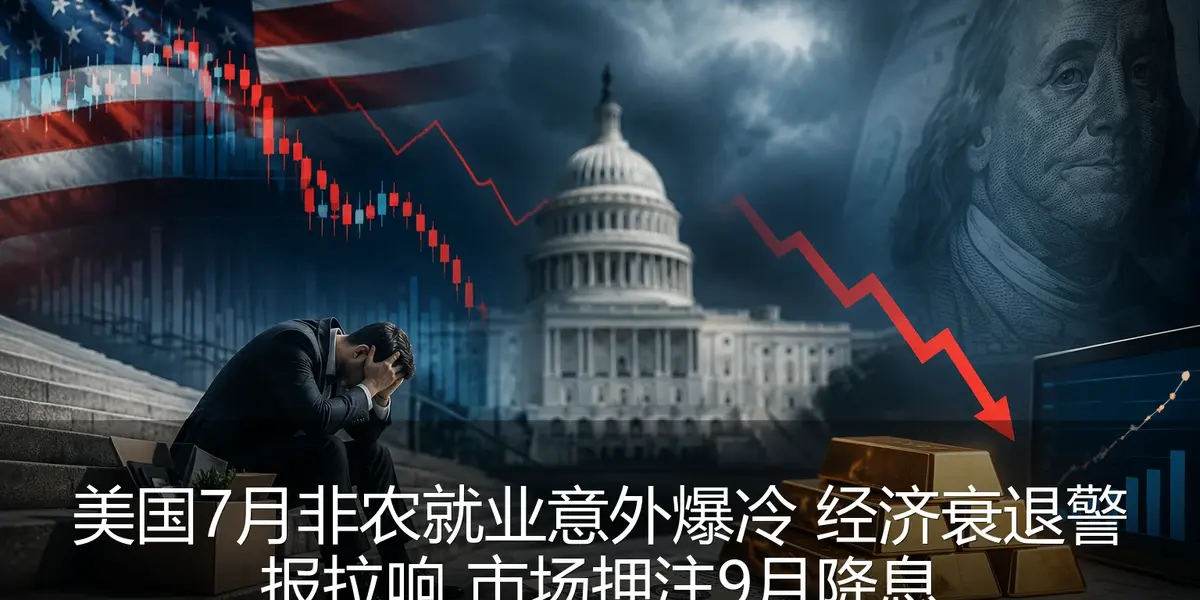
On August 1, the July non-farm employment report released by the US Department of Labor caused剧烈震荡 in global markets. The data showed that July non-farm employment increased by only 128,000, far below the market expectation of 250,000, marking the smallest increase since December 2024. At the same time, the unemployment rate unexpectedly rose to 4.9%, a significant increase from the previous 4.5%; average hourly wages increased by only 0.2% month-on-month, with the annual growth rate slowing to 3.8%. This disappointing data set, like a deep-water bomb thrown into the financial market in an observation period, suddenly sounded the alarm for economic recession.
Data Weakened Across the Board, Clear Signal of Labor Market Cooling
Looking at细分 industries, July employment growth was mainly concentrated in healthcare, leisure and hospitality, and government sectors, while manufacturing, construction, and retail all experienced varying degrees of decline. Private non-farm employment increased by only 108,000, with service sector employment growth significantly slowing. What made the market more alert was that the labor force participation rate decreased from 62.6% to 62.4%, meaning more people gave up looking for jobs, while the number of people working part-time for economic reasons increased by 370,000 to 4.8 million. These micro-indicators consistently point to the labor market losing its resilience, and the upward trend in unemployment may just be beginning.
Combined with the previously released July ADP employment data (only 150,000 increase) and continuously rising initial jobless claims, the cooling of the US labor market is not monthly noise but a trend turning point. BGU Data Research Institute analysis believes that in a high-interest rate environment, corporate hiring willingness continues to shrink, especially SMEs are more sensitive to costs, with hiring freezes and even layoffs increasing, which provides logical support for the continued weakening of employment data.
Market Turmoil: Dollar Breaks Down, Gold Soars, Stock Index Futures Dive
After the non-farm data release, the market reaction was extremely intense. The dollar index plummeted 0.9% in a short period, falling below the 99.8 level, hitting a new low since July 2023; the 10-year US Treasury yield fell 15 basis points to 4.02%, while the 2-year yield plummeted 22 basis points to 3.85%, narrowing the yield curve inversion, suggesting that market pricing for economic recession is accelerating. The three major US stock index futures plunged on the news, with Nasdaq futures falling more than 2% at one point and Dow futures falling more than 1.5%.
Haven assets rose across the board. Spot gold surged $40 in a short time, breaking through the $2000/oz integer level, hitting a high since April 2025; COMEX silver rose more than 3%. The weakening dollar combined with rising rate cut expectations gave the precious metals market dual upward momentum. Capital simultaneously flowed into the Treasury market, showing that investors are rapidly reducing risk exposure.
Fed's Dilemma: Inflation Not Achieved While Employment Loses Speed First
What makes the Fed more headache is that this weak employment report is not an isolated event. The previously released June core PCE year-on-year was still as high as 2.8%, far above the 2% target, showing that inflation stickiness is still persistent. The weakening of July non-farm puts the Fed in the classic dilemma of "stagflation": economic data is deteriorating, but price pressure has not yet eased, making policy choices much more difficult.
However, the market has clearly placed concerns about recession above inflation. Federal funds rate futures show that traders expect the probability of the Fed cutting rates at the September meeting to soar from 35% to 75%, and even began to expect another rate cut in November or December, with a possible cumulative rate cut of 50-75 basis points for the whole year. The CME FedWatch tool shows that the probability of three rate cuts by the end of 2026 exceeds 50%.
Goldman Sachs, Morgan Stanley and other institutions quickly lowered US economic expectations. Goldman Sachs raised the probability of a US recession in the next 12 months from 25% to 40%, and warned that the accelerated deterioration of the labor market may force the Fed to cut rates by 50 basis points in September, not just a regular 25 basis point cut. Morgan Stanley believes that the Fed will have to enter a "continuous rate cut" cycle to hedge the economic downside risks from fiscal tightening and credit conditions tightening.
Global Chain Reaction: Non-US Currency Rally, Emerging Markets Get Breathing Room
The plunge in the dollar index has spillover effects on global assets. Euro, yen, pound and other major non-US currencies all appreciated significantly against the dollar, with the yen/dollar appreciating by more than 2% in a single day, once approaching the 150 level. The RMB exchange rate also showed significant strengthening, with both onshore and offshore rates breaking through 7.05, the highest since May 2025. This to some extent alleviates the pressure of capital outflow from emerging markets, but at the same time poses challenges to the competitiveness of export-oriented economies.
For commodities, dollar depreciation usually constitutes a positive factor, but the shadow of economic recession suppresses demand expectations, so oil prices showed a first-up-then-down oscillation pattern. Industrial metals like copper weakened slightly due to demand concerns. Conversely, gold, under the dual logic of safe haven + rate cuts, is regarded by many institutions as the most certain allocation asset in the next quarter. BGU Data Research Institute's senior analyst pointed out: "From historical experience, when non-farm new employment falls below 150,000 and the unemployment rate shows an upward turning point, gold's average increase in the next three months exceeds 6%. The current macro environment is highly similar to the eve of the rate cut cycle after the 2009 subprime crisis."
Follow-up Focus: July CPI and Jackson Hole Global Central Bank Symposium
How this non-farm data will affect the Fed's policy path still needs confirmation from more data. In the next two weeks, the market will closely follow July CPI, PPI, and retail sales data. If inflation data also falls back, then a September rate cut will almost become a certainty; conversely, if inflation remains sticky, the Fed will face a more difficult risk balance.
In addition, the Jackson Hole Global Central Bank Symposium in late August is the next key node. The speech by the Fed Chair at that time may set the tone for the September meeting and reveal more clues about the adjustment of quantitative tightening (QT). If Powell clearly indicates that the rate cut cycle is about to begin, then risk assets are expected to stage a rebound, while the dollar will enter a medium-term downward channel.
Investment Insights: Embrace Certain Assets, Strictly Control Position Risks
For investors, data volatility has significantly increased under the current macro environment, making risk management and asset allocation crucial. In portfolio construction, it is recommended to moderately increase the allocation ratio of safe-haven assets such as gold and medium-to-long-term US Treasuries, reduce stock positions and exposure to high-growth stocks; at the same time, pay attention to emerging market opportunities under dollar weakness, but be alert to debt and exchange rate risks of individual countries.
BGU Data Academy repeatedly emphasizes in its "Risk Awareness Training" course: When the market panics, data and discipline are the best friends. Investors should closely track leading indicators such as weekly initial jobless claims, manufacturing PMI, and inflation expectations, use systematic data frameworks to respond to possible policy turning points, rather than being dominated by the noise of single data points.
This information is output by BGU Data Flash based on market open data and model analysis, for reference only, and does not constitute specific investment advice. The market has risks, and investment requires caution.




