Geopolitical Risks vs. Rate Hike Expectations: Bull-Bear Battle After International Gold Breaks Above $4070
Summary
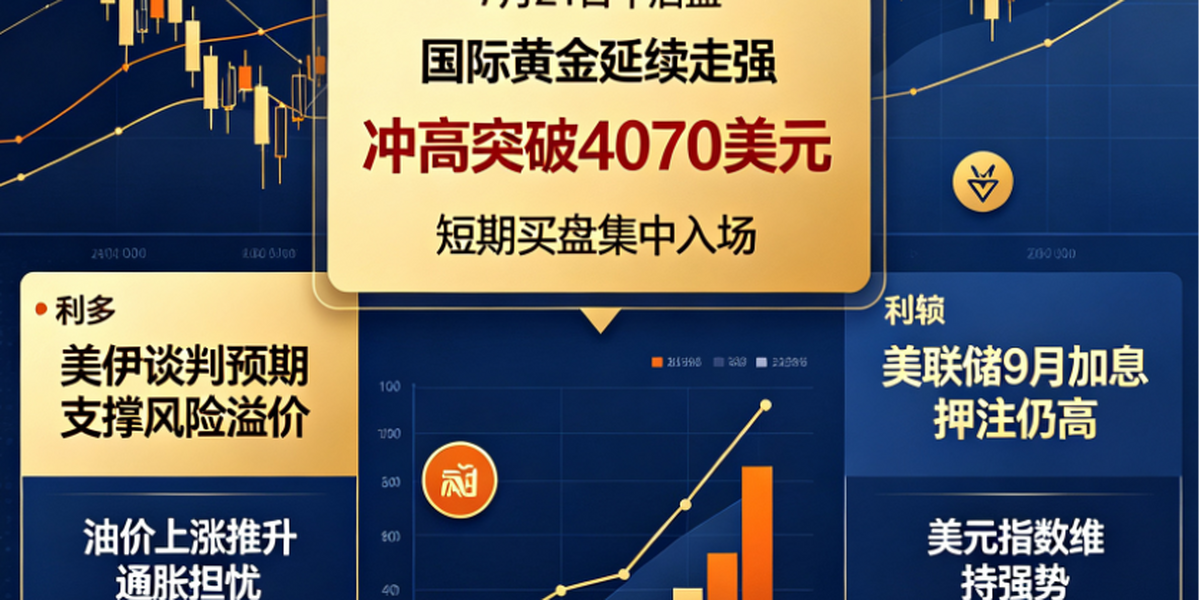
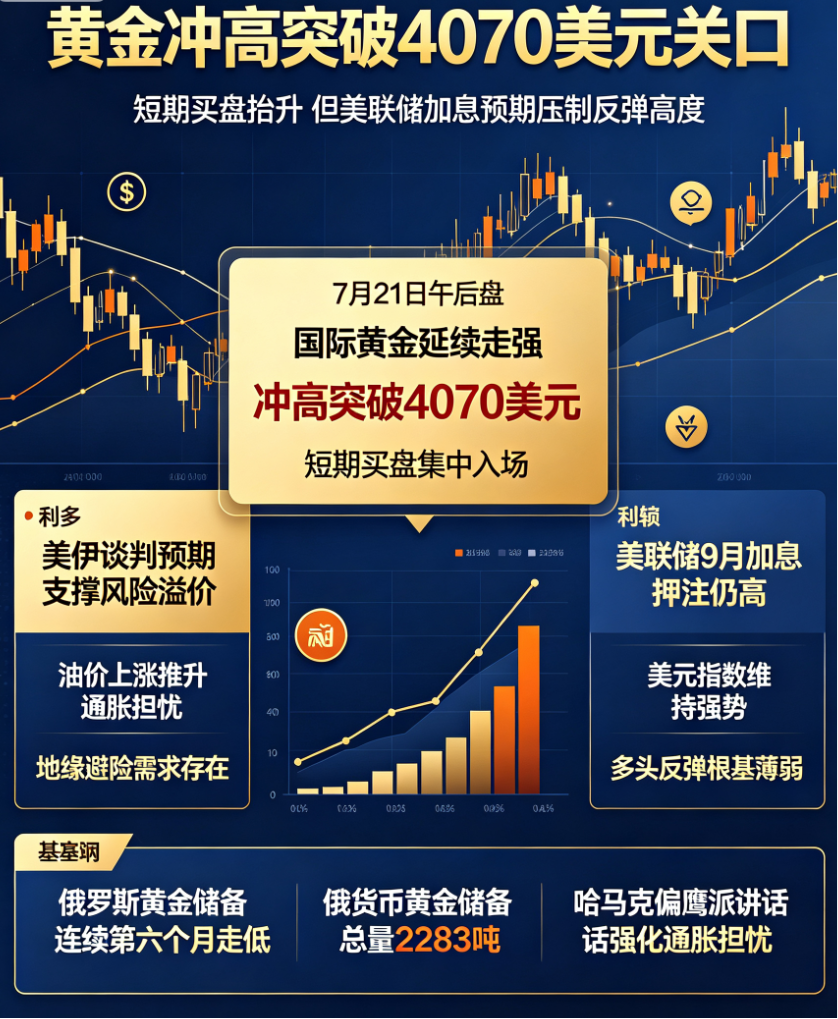
On Tuesday (July 21) afternoon, international gold continued its upward momentum, surging past the $4070 mark as concentrated short-term buying pushed prices higher. The rally was primarily boosted by expectations of US-Iran talks weighing on oil prices, but Fed rate hike pricing remains elevated, with institutions betting on a September rate hike, making the bullish rebound fragile. This article deeply analyzes the core drivers of the current gold market from the perspectives of Russia's gold reserve changes, Middle East geopolitical situation, Fed policy signals, and global market linkages, while providing an outlook on future trends.
1. Market Review: Structural Pressures Behind the Short-Term Surge
On Tuesday afternoon, the international gold market showed significant fluctuations. During the shift between Asian and European trading sessions, spot gold rapidly surged, breaking through the $4,070/oz mark to hit a near-one-week high. Market participants widely believe this rally is closely related to US-Iran talks - mediators proposed a ten-day ceasefire to negotiate restarting the interim US-Iran agreement, which temporarily weighed on crude oil prices, thereby weakening inflation expectations' suppression on gold. Meanwhile, short covering and concentrated entry of speculative buying further amplified gains.
However, from a broader perspective, the sustainability of this rebound is questionable. The Fed's rate hike cycle is not over, with September rate hike probability still high, and the dollar index maintaining a strong posture, fundamentally limiting gold's upside. The bulls' "fragile foundation" is reflected in the fact that once geopolitical news reverses or the Fed delivers a more hawkish signal, gold prices could quickly give back gains.
2. Russia's Gold Reserves Continue to Decline: A Microcosm of Geopolitical Economy
In June 2026, Russia's monetary gold holdings in international reserves fell for the sixth consecutive month, down 0.4% month-on-month, with holdings decreasing by 9.3 tons. As of July 1, Russia's total monetary gold reserves stood at 2,283.00 tons. Affected by gold price fluctuations, the book value of Russia's gold reserves shrank 8.25% in June, falling from $325.872 billion in May to $298.991 billion in July. Gold's share in Russia's total international reserves also declined, from 43.6% to 41.5%.
This trend reflects multiple implications. First, the Russian central bank's active or passive reduction may stem from adjustments in its foreign exchange reserve management strategy - under ongoing Western sanctions, Russia needs to maintain foreign exchange liquidity to support imports and fiscal spending. Second, the declining gold reserve share also reflects the impact of gold price volatility on sovereign balance sheets. For the global gold market, while Russia's reduction is limited in scale, it psychologically exacerbates some investors' doubts about gold's long-term allocation value.
Notably, Russia's reduction did not trigger a sell-off; instead, during the gold price correction in June, Asian central banks and some retail investors bought the dip. This shows that gold demand among different entities is diverging, with geopolitical premiums and monetary credit reconstruction logic still supporting gold's long-term value center.
3. Escalating Middle East Situation: Ceasefire Proposal and Military Strikes Coexist
According to Iranian sources, mediators proposed a ten-day ceasefire to negotiate restarting the interim US-Iran agreement. However, Iran's Islamic Revolutionary Guard Corps immediately issued a statement, striking US military targets in Bahrain and Kuwait in three phases. Meanwhile, the New York Times cited US officials saying the US military plans to deploy additional F-16, F-35 fighters and aerial tankers to the Middle East. These actions indicate that conflict risk in the Middle East has not substantially decreased due to the ceasefire proposal, and may further escalate.
From the gold market transmission mechanism, geopolitical conflict escalation usually benefits safe-haven assets. However, the core trigger of current US-Iran tensions lies in oil prices - if Iranian crude supply is disrupted, global energy prices will rise, exacerbating inflation pressure. Rising inflation expectations in turn strengthen market expectations of continued Fed rate hikes, ultimately creating a "double blow" to gold: on one hand, higher oil prices drive up real interest rates; on the other hand, rate hike expectations suppress gold's holding appeal.
Therefore, the market's reaction to the Middle East situation shows clear "swinginess": when ceasefire news emerges, oil falls, gold benefits; when military conflict escalates, oil rises, gold comes under pressure. This short-term news-driven volatility leaves gold prices without a clear directional anchor.
4. Fed Hawkish Tone: Rate Hike Expectations Dominate Market Sentiment
Federal Reserve official Beth Hammack recently delivered a hawkish speech, emphasizing that inflation risks persist and stating that if price pressures continue, the Fed may need to raise rates further to curb inflation. She specifically noted that energy prices, supply chain costs, insurance premiums, and AI data center-related inputs could create new price pressures. Markets widely believe Hammack's comments reinforced concerns within the Fed about "inflation lasting longer than expected."
The direct consequence of this stance is that the dollar index received support, remaining relatively strong. Since gold is priced in dollars, a stronger dollar means gold faces downward pressure. Meanwhile, the US Treasury yield curve also saw upward pressure, with the 10-year yield approaching 4.5% again, further weakening gold's appeal as a non-yielding asset.
Notably, the Fed is not monolithic. Some officials have recently expressed concerns about economic slowdown, arguing that excessive rate hikes could trigger recession risks. However, based on current market pricing, the probability of a 25 basis point rate hike in September exceeds 60%, and this expectation is unlikely to dissipate in the short term. For gold bulls, only a clear signal of a rate hike pause or end can provide genuine rebound momentum.
5. Three-Dimensional Driving Framework Amid Bull-Bear Interplay
From a global market perspective, gold is currently influenced by multiple intertwined factors, which can be summarized into three core dimensions:
First, the tug-of-war between safe-haven demand and inflation expectations. Geopolitical risk escalation (e.g., Middle East conflict, Russia-Ukraine standoff) could boost safe-haven flows into gold; however, the same event-driven oil price rise pushes up rate expectations through the inflation channel. This "self-contradiction" temporarily suppresses gold's safe-haven appeal.
Second, the decisive role of the dollar's trend. The dollar index remains high supported by macroeconomic resilience and rate hike expectations, exerting continuous pressure on dollar-denominated gold. Only when US economic data clearly weakens or Fed policy pivots can the dollar fall, allowing gold to see a trend opportunity.
Third, long-term support from physical demand and central bank gold purchases. Despite Russia's reduction, central banks in China, India, and others have not stopped buying. The global central bank gold reserve "de-dollarization" trend continues, providing long-term floor support for gold prices.
6. Outlook: Short-Term Volatility Pattern Unlikely to Change
Looking ahead to the coming week, the gold market will closely watch the following events:
- US-Iran talks progress: If the ceasefire agreement advances, falling oil prices will benefit gold; conversely, military conflict escalation may pressure gold prices.
- US economic data: Focus on GDP preliminary reading, core PCE price index, and consumer confidence index. If data surprises to the upside, it will further strengthen rate hike expectations and weigh on gold.
- Fed officials' speeches: Any guidance on the rate path will trigger market volatility.
Technically, gold faces strong resistance near $4,070, which is also a previous trading concentration zone. If it cannot firmly hold above $4,100 in the near term, it may retreat to the $4,000-$4,010 range for support. In the medium to long term, gold is still in a large-cycle consolidation bottoming phase, and the start of a trend requires a fundamental shift in Fed policy expectations.
Conclusion
Tuesday's breakout rally in gold is essentially a short-term pulse driven by geopolitical news, not a signal of trend reversal. Russia's declining gold reserves, the continuation of the Fed's hawkish stance, and the volatility of the Middle East situation together create the complex picture of the current gold market. When participating in trading, investors should fully recognize the fragility of the bullish foundation and be wary of correction risks from news reversals. Meanwhile, monitoring the dollar trend, oil price changes, and central bank policy statements will be key to grasping future gold price direction. For medium- and long-term investors, current prices do not fully reflect gold's safe-haven and inflation-hedging value, so phased allocation may still be a feasible strategy, but be prepared for increased volatility.