Sure, the following is a professional and complete article created based on the reference content and requirements you provided.
Title: Geopolitical Conflict Can't Halt "Seesaw" Effect: Gold Pressures $4,000, Market Games Inflation and Rates
Keywords: US-Iran Conflict; Gold Price; Crude Oil Price; Inflation Expectations; Fed Rate Hike; Safe-Haven Assets
Introduction: When Safe-Haven Assets No Longer "Safe Haven"
Geopolitical turmoil has historically been a catalyst for gold price increases, but the recent escalation of the US-Iran conflict failed to ignite the precious metal's safe-haven spark. Instead, international gold prices quickly retreated after a brief spike, once falling below the $4,000 per ounce mark. This seemingly abnormal move actually reveals the complex and subtle underlying logic of current global financial markets: when inflation expectations triggered by surging oil prices overshadow the risk aversion brought by geopolitical conflict, "rate suppression" becomes the core factor determining gold's direction. In this gold-oil "seesaw" game, gold is undergoing a deep structural adjustment.
I. Strait of Hormuz "Blockade" and the Gold-Oil "Seesaw"
On July 19, 2026, a report from Iran's Fars News Agency exploded the global energy market. Citing informed sources, the report stated that shipping traffic through the Strait of Hormuz had "dropped to zero" and warned that the strait would remain closed as long as the US continued provocative actions. As the world's most important oil transportation chokepoint, the potential "blockade" risk directly drove a strong breakout in international oil prices, with ICE Brent crude hitting $91.42 per barrel and WTI crude climbing to $84.6 per barrel.
However, gold did not rise on safe-haven demand as traditional logic would suggest. Spot gold fell below the $4,000 mark on July 20, briefly hitting a low of $3,982.32 per ounce. Liang Yonghui, Deputy General Manager of Shandong Zhaojin Gold & Silver Refining Co., Ltd., pointed out that the core transmission chain of this conflict is "oil price rise → inflation expectations heat up → Fed rate hike expectations strengthen → non-yielding asset gold under pressure." The safe-haven premium that gold had built up in previous geopolitical conflicts now has to be given back and corrected in the current high-rate environment. This is the classic gold-oil "seesaw" effect—inflation expectations outweigh geopolitical risk-aversion logic.
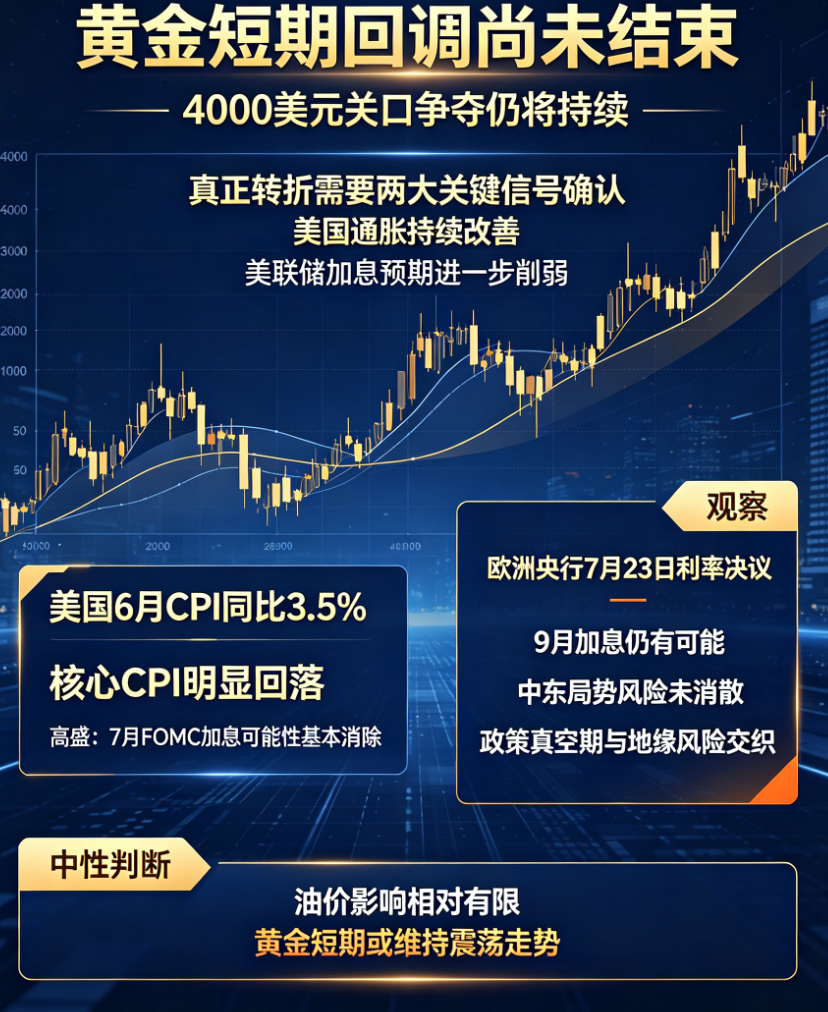 Figure note: The chart clearly shows the divergence between crude oil prices and gold prices under the current gold-oil "seesaw" effect, reflecting the market's repricing of inflation and rate expectations in the short term.
II. Bull-Bear Battle at the $4,000 Mark
Currently, market funds are fiercely contesting around the $4,000 per ounce level, a psychologically and technically key level. Latest positioning data from the U.S. Commodity Futures Trading Commission (CFTC) shows that as of the week ending July 14, 2026, non-commercial net long positions in COMEX gold futures decreased by 7,564 contracts to 186,682, with the share falling to 48.6%. This means bulls are scaling back while bears are strengthening.
In this context, the core divergence between bulls and bears is whether the Federal Reserve will adopt a more aggressive rate hike path due to rising energy prices. CME FedWatch data shows the market's probability of a December rate hike has climbed from 73% previously to 82%. Although the June US CPI data came in cooler than expected, briefly easing rate hike concerns, the energy price shock from the US-Iran conflict is reigniting fears of "inflation stickiness."
Guotai Fund analysis suggests that gold's core contradiction is currently the game between "geopolitical inflation" and "rate cut expectations." Oil prices push up inflation, reinforcing high rate expectations; while improving CPI data provides short-term support for gold prices. The two forces pull back and forth, causing gold to oscillate in a range of $3,959 to $4,104. In the short term, the market is in a process of correcting previous overpricing, and the pattern of gold's weak oscillation and bottom-building is unlikely to change in the near term.
III. Mismatch Between Long-Term Narrative and Short-Term Reality
Despite strong bearish sentiment in the short term, many institutions have not lost confidence in gold's medium-to-long-term outlook. BofA analysts noted in a research report that although gold prices may continue to face pressure between August and September and could even test the $3,600 level for a firmer bottom, they simultaneously proposed a phased buying strategy, recommending moderate accumulation below $4,000. BofA still believes gold could reach the $6,000 level in 2027.
The core logic supporting this long-term bullish view is the structural trend of "de-dollarization." Liang Yonghui pointed out that de-dollarization is one of the core narratives underpinning this round of gold's long-term bull market. Although the dollar has strengthened in the short term, this is a cyclical fluctuation that does not conflict with the structural trend of de-dollarization spanning over a decade. Central banks' strategic adjustment of reserve asset structures and gradual reduction of dollar dependence are still ongoing, providing long-term support for gold prices.
Meanwhile, global fiscal deficits, the normalization of geopolitical tensions, and monetary system uncertainties further strengthen demand for gold as a safe asset. This provides a layer of long-term bullish "cushion" for gold prices currently under pressure.
IV. Waiting in the Policy Vacuum: Awaiting Two Key Signals
Institutions generally believe that gold's short-term correction is not yet over, and a definitive market turnaround requires confirmation of two key signals.
First, whether US inflation data can continue to improve. This is the most direct clue. Goldman Sachs Chief Economist Jan Hatzius noted in the latest report that the improvement in inflation data has essentially eliminated the possibility of a rate hike at the July FOMC meeting. The core anchor for subsequent trends remains US inflation data. However, before the risk of escalation in the Middle East situation is eliminated, the market's pricing bias towards tightening policy is unlikely to be corrected.
Second, policy moves by major central banks such as the European Central Bank are equally critical. The ECB is set to announce its interest rate decision on July 23. The market generally expects it to keep rates unchanged. But Bloomberg Intelligence notes that elevated commodity prices make a September rate hike still possible. Until these two turning signals are clear, the gold market will remain in a phase of interplay between "policy vacuum" and "geopolitical risk interweaving."
CICC Wealth Futures offered a relatively neutral assessment: Overall, oil prices have a relatively limited impact on gold. If oil prices stop here without further sharp spikes, gold is expected to oscillate in the short term. Market participants need to wait patiently until new macro signals become clear.
Conclusion: Through the Fog, Awaiting Bloom
Gold's hesitation around the $4,000 mark is not just a direct contest between bulls and bears; it is a comprehensive examination of the global economic cycle, geopolitical landscape, and monetary policy logic. Currently, the coexistence of the gold-oil "seesaw" effect and the long-term de-dollarization trend means gold faces both short-term pains and long-term opportunities. For investors, understanding this round of structural adjustment is more important than simply betting on direction. In the intertwining of policy vacuum and geopolitical risks, staying clear-headed and awaiting confirmation of the two key signals may be the wise choice to navigate the short-term fog and embrace long-term value.